
How to Choose a Charcoal Grill Manufacturer: A 2026 Sourcing Guide
Selecting a charcoal grill supplier forms part of supply chain planning. The process covers market fit along with safety standards, packaging details, lead time, and after-sales support. Low unit price often turns costly if a grill fails inspection, wastes container space, or leads to returns. The framework allows buyers to compare suppliers and prepare a clear request for quotation.
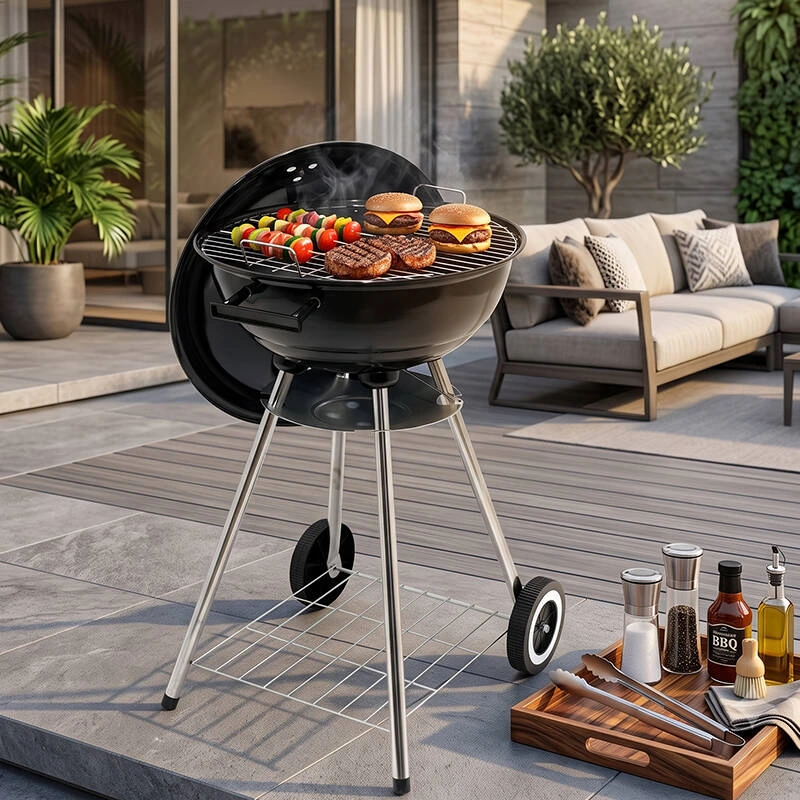
Define Your Charcoal Grill Product Brief Before Contacting a Factory
Choose the Right Charcoal Grill Type for Your Target Market
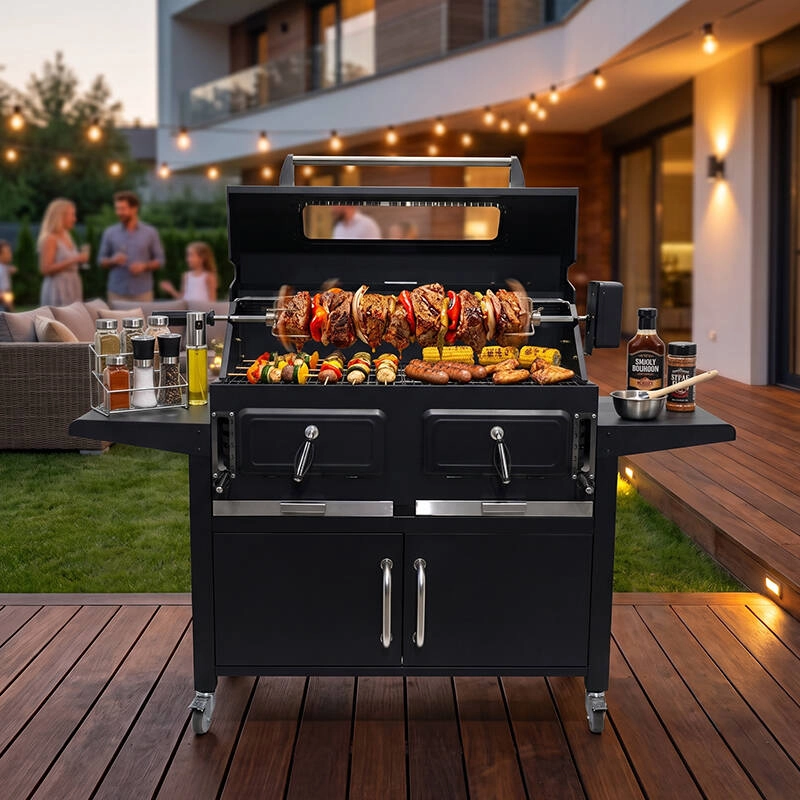
Start with the user and sales channel. A folding grill suits camping and entry-price programs, while a kettle model fits backyard retail. Large trolley grills provide more cooking space and heat-control options.
| Target segment | Suitable format | Main buying focus |
| Camping and travel | Folding portable grill | Packed size, handles, storage |
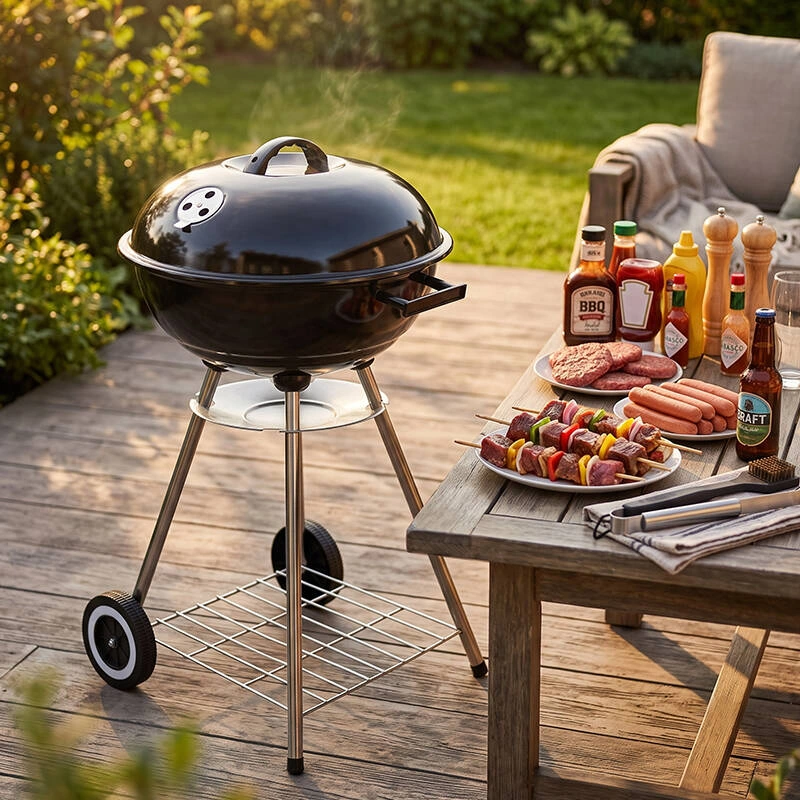
| Family backyard use | Kettle grill | Cooking diameter, airflow, ash removal |
| Premium retail | Adjustable trolley grill | Heat control, workspace, stability |
Set the Target Size, Features, Price Tier, and Sales Channel
Specify assembled size, packed size, cooking area, target retail price, and channel before requesting a quote. Marketplace sellers often focus on compact cartons and simple assembly. Supermarkets often require strong packaging, clear manuals, barcode placement, and reliable replenishment.
Create a “must-have” list and a separate “optional” list. This prevents unnecessary features from raising costs and makes quotations easier to compare.
Compare Charcoal Grill Materials and Performance Specifications
Evaluate Steel Grade, Thickness, Coating, and Corrosion Resistance
Ask the supplier to identify the material used for the bowl, lid, charcoal pan, cooking grid, legs, fasteners, and handles. “Steel construction” is too vague. Request the steel specification, sheet thickness, surface treatment, and food-contact material details.
Porcelain enamel is often selected for high-temperature areas, while powder coating is commonly used on exterior frames and shelves. Stainless steel may suit grids or selected components, while cast iron grids provide thermal mass but add weight and maintenance requirements.
The useful question is not “Which material is best?” but “Which specification fits the target price, climate, expected service life, and shipping weight?” Heavy construction may support durability, but it can also increase freight costs and make the grill less suitable for portable retail programs.
Check Airflow, Heat Control Design
Temperature control depends on airflow and the distance from the fuel to the food. Inspect the number, location, and movement of the vents.
Also check whether the lid thermometer is positioned to provide useful information rather than merely adding another feature. Product testing should include vent adjustment, lid operation, and temperature stability under realistic cooking conditions.
Review Stability, Portability, Assembly, and Ash Removal
A grill that performs well but arrives with confusing hardware can still create poor reviews. Evaluate:
- Leg and wheel stability on uneven surfaces
- Sharp-edge control around stamped and welded parts
- Handle clearance from hot surfaces
- Assembly steps and required tools
- Ash-catcher removal without spilling
- Folded dimensions and locking points
Ask for both an assembled sample and a packed sample. The assembled unit reveals stability, access, and ease of use. The packed sample reveals carton protection, component organization, hardware labeling, and the likelihood of damage during shipping or warehouse handling.
Verify Compliance, Quality Control, and Factory Capability
Match Product Testing and Documentation to the Destination Market
Compliance should be linked to the exact product, material, and destination. Request current reports for the purchased model, not a general certificate issued for another item. Depending on the market, documentation may cover grill safety, food-contact materials, chemical restrictions, labeling, manuals, and packaging.
A document check should confirm the model reference, test standard, issue date, tested materials, and limitations. Available qualifications include ISO 9001, ISO 14001, BSCI, Sedex, EN 1860, LFGB, FDA, CE, UKCA, PAHs, and REACH-related compliance. Buyers should still verify which documents apply to the selected grill and destination market.
Do not treat a logo on a supplier presentation as sufficient evidence. Request complete reports where appropriate and check whether product construction has changed since testing.
Audit Quality Control, Traceability, Capacity, and Lead Time
Wholesale supplier evaluation should go beyond a showroom inspection. KEYO BBQ recommends checking incoming-material control, first-article approval, welding and surface inspection, assembly checks, functional testing, packaging verification, and final random inspection. Production records should connect each batch to materials, inspection results, and corrective actions.
Capacity requires proper context, too. People should ask about usual output levels, peak season demands, options for subcontracting, available warehouse space, and any backup plans in place. The production system includes R&D, customization, manufacturing, quality control, packaging, and logistics. Dedicated staff members support the R&D work and quality control tasks. Discussions about lead time need to go beyond just the expected production period. Teams must confirm exactly when the schedule starts. They also need to know whether the process begins after a deposit payment or after sample approval. In addition, packaging approval steps, required testing, holiday periods, or material shortages can all influence final delivery dates.
Evaluate OEM/ODM, MOQ, Packaging, and Total Landed Cost
Compare OEM, ODM, and Private-Label Customization
Private labeling usually starts with an existing structure and changes the logo, color, manual, or carton. OEM may involve component changes or a buyer-owned design. ODM combines supplier development capabilities with customization for a target market.
Before approving changes, identify which items require new tooling, retesting, revised packaging, or a higher minimum order. A color change may affect coating validation and scheduling, while structural changes require more engineering review than a logo or carton update.
Buyers should also confirm ownership of drawings, tooling, packaging artwork, and product photography. These details are particularly important when developing an exclusive retail line.
KEYO BBQ provides full OEM/ODM services such as logo printing, structural customization, and packaging design.
Clarify MOQ, Tooling, Samples, Payment Terms, and Production Schedule
Request a commercial breakdown instead of a total price. The quotation should state:
- Minimum order for the standard model
- Minimum order for color, logo, or packaging changes
- Tooling and sample charges
- Payment milestones
- Sample approval time
- Production lead time
- Peak-season validity
- Spare-parts policy
Do not assume one MOQ applies to every configuration. Existing models, customized packages, and newly engineered products may require different volumes and schedules.
The approved sample should be documented with photographs, specifications, colors, component details, packaging, and signed confirmation. This creates a clear reference for mass-production inspection.
Calculate Packaging Efficiency and Total Landed Cost
The lowest FOB price is not always the lowest final cost. Compare carton dimensions, gross weight, units per container, protective materials, inspection fees, freight, duty, spare parts, and return risk.
Supplier A may quote less per grill but load fewer units because of inefficient packaging. Supplier B may cost slightly more but reduce freight per unit and damage claims. A landed-cost sheet should therefore include direct purchasing expenses and probable after-sales costs.
Packaging should also be tested for real distribution conditions. Consider carton strength, internal protection, hardware bags, moisture exposure, handling marks, assembly instructions, and replacement-part identification.
Build a Supplier Shortlist and Send a Comparable RFQ
Use a Charcoal Grill Supplier Scorecard and RFQ Checklist
Score each candidate on product fit, material transparency, test documentation, quality control, customization, packaging, capacity, lead time, communication, and after-sales support. Apply equal weight to every bidder. A complete RFQ needs grill type, cooking area, packed dimensions, materials, coating, features, destination, compliance needs, quantity, branding, packaging, delivery date, and shipping term. Attach drawings when possible. Identify mandatory requirements at the same time.
A simple scoring model can allocate more weight to quality and compliance than to price:
- Product and specification fit: 25%
- Quality control and compliance: 25%
- Commercial terms and landed cost: 20%
- Capacity and delivery reliability: 15%
- Customization and engineering support: 10%
- Communication and after-sales support: 5%
This process makes technical and commercial differences visible before sampling and prevents the purchasing decision from being based on unit price alone.
FAQ
Q: How do I choose a reliable charcoal grill manufacturer?
A: Compare specialization levels, material details, model-specific test reports, quality-control steps, production capacity, and experience with similar sales channels. Approve both an assembled sample and a packed sample before placing a bulk order.
Q: What certifications are required when importing charcoal grills?
A: Requirements vary by destination, product construction, food-contact components, and retail channel. Confirm the applicable standards with a qualified testing provider and request reports identifying the exact model and tested materials.
Q: What materials should wholesale buyers compare in a charcoal grill?
A: Compare body and lid steel, sheet thickness, enamel or powder coating, cooking-grid material, charcoal-pan construction, fasteners, handles, and corrosion protection. The correct combination should match the target price and expected use.
Q: What information should be included in a charcoal grill RFQ?
A: Include product type, dimensions, cooking area, materials, coating, features, target market, compliance needs, order volume, customization, packaging, delivery schedule, and shipping terms. Clear specifications make quotations easier to compare.