
BBQ Grill Supplier Checklist for Importers
Finding a BBQ grill supplier is easy. Finding one that can support repeat orders, OEM projects, product compliance, and stable retail programs is much harder.
For an importer, the lowest quotation is rarely enough. A supplier also needs to understand product specifications, sample approval, quality control, packaging, and the requirements of the destination market. This becomes even more important when buyers compare barbecue grill manufacturers in China or source several grill categories from one partner.
A practical supplier checklist therefore starts with evidence. Before discussing a purchase order, buyers should confirm what the factory can make, how customization is handled, how quality is controlled, and whether the supplier can support the project after the first sample.
What Should Importers Verify Before Shortlisting a BBQ Grill Supplier?
A useful first screening should answer one question: does this supplier actually fit the project?
Confirm the Supplier Fits Your Product Categories and Target Market
Start with the product range. A supplier that mainly makes one simple charcoal model may not be the right choice for a buyer planning a wider retail assortment.
Importers should confirm:
1. Which grill categories are manufactured regularly
2. Whether the required size and construction are available
3. Whether OEM or ODM work is supported
4. Whether the supplier has experience with the intended sales market
5. Whether products can be prepared for wholesale or private-label programs
This matters when comparing very specific sourcing options. A buyer searching for China kettle charcoal grill BBQ suppliers may have completely different requirements from another buyer sourcing wholesale gas grills or a camping grill ODM project.
The same applies to product positioning. A compact grill for camping has different packaging, portability, and retail expectations from a large trolley charcoal grill.
Ask for Verifiable Evidence Instead of Comparing Price Alone
A low unit price can look attractive until the sample, packaging, or production version differs from what the buyer expected.
Before shortlisting suppliers, request evidence related to the actual project. That can include a product specification, physical or video sample review, manufacturing details, quality-control procedure, packaging proposal, and relevant compliance information.
The objective is not to collect as many files as possible. It is to check whether the supplier can connect the quotation to a clearly defined product.
For example, when comparing China grill suppliers, two quotations may appear similar. One supplier may have already clarified materials, dimensions, accessories, packaging, and inspection points. Another may have quoted only from a product photo. Those are not equivalent offers.
Can the BBQ Grill Supplier Match Your Product and OEM Requirements?
OEM sourcing becomes more reliable when the product definition is settled before mass production.
Match Grill Type, Configuration, and Retail Positioning First
Importers should begin with the selling scenario.
For a kettle BBQ wholesale program, cooking area, grill height, mobility, lid structure, ash handling, and packaging size may affect whether the product fits the retailer’s range. For a portable grill, folded dimensions and ease of transport can become more important.
OEM requirements should therefore be written around the final product, not around a vague request such as “make something similar.”
For buyers searching for an OEM kettle barbecue factory or an OEM kettle charcoal BBQ solution, useful questions include:
- What dimensions must remain fixed?
- Which components can be changed?
- Is branding required on the product, carton, or both?
- What sample becomes the production reference?
- How will later changes be approved?
This prevents small changes from quietly entering production.
Confirm the Sample, Customization Scope, and Change-Control Process
A sample should function as a practical approval point.
The buyer and supplier should agree on what has actually been approved: dimensions, materials, structure, surface treatment, color, accessories, branding, and packaging where applicable.
At KEYO BBQ, we provide OEM and ODM support covering development, customization, manufacturing, quality control, packaging, and logistics. Our grill range includes charcoal, gas, electric, kettle, and smoker products.
For example, our PG07-070 22.5-inch round kettle charcoal grill measures 69 × 58 × 98 cm, has a 54 cm cooking-area diameter, and uses iron construction.
For buyers looking for a larger charcoal format, our FT01-070 measures 156 × 61.5 × 119 cm, provides a 74.8 × 47.6 cm cooking area, and has a 14 cm adjustable-height range.
Portable programs have different needs. Our ZS01-014 measures 56 × 31 × 36.2 cm with a 41 × 26 cm cooking area and a folding design intended for easier transport and storage.
These differences show why an importer should choose the product architecture first and discuss customization second.
How Should Importers Check Manufacturing, Quality, and Compliance Readiness?
A good sample does not automatically guarantee a good production run. Importers also need to understand what happens after approval.
Review Manufacturing and Quality-Control Evidence at Supplier Level
The supplier should be able to explain how the approved product moves through production and inspection.
A simple evaluation table helps:
| Product reference | Approved sample and specification |
| Production | Main manufacturing steps and responsibilities |
| QC | Inspection stages and acceptance criteria |
| Changes | Written approval before alterations |
| Final check | Product condition before shipment |
KEYO BBQ has an in-house QC team, and our broader order process includes manufacturing and quality-control support.
This kind of process visibility is particularly useful when comparing kettle barbeque grill factory options or BBQ grill wholesale distributors that may rely on different manufacturing sources.
Verify Compliance for the Actual Product and Destination Market
Compliance should be checked against the exact grill and the country where it will be sold.
KEYO BBQ works with systems and requirements including ISO 9001, ISO 14001, BSCI/Sedex, EN 1860, LFGB, FDA, GS, CE, UKCA, PAHs and REACH. The appropriate requirements still depend on the product and destination market.
Instead of asking only, “Do you have certificates?” ask which requirement applies to the selected model and whether the relevant evidence can be provided before the order proceeds.
That small change makes the compliance discussion much more useful.
What Commercial and Delivery Terms Should Be Confirmed Before the Purchase Order?
Technical approval is only half of supplier qualification. The commercial side also needs clear boundaries.
Confirm Quantity, Quotation Assumptions, Samples, and Communication
An importer should know exactly what the quotation covers.
Confirm the quantity, configuration, customization, packaging assumptions, sample status, payment conditions, and responsibilities for any changes.
This is especially important when an inquiry uses broad phrases such as China kettle style grill wholesalers or round kettle BBQ wholesalers. Search terms identify a potential supplier category, but they do not define the purchase specification.
A practical rule is simple: if a requirement can change the cost or production method, put it in writing before the purchase order.
Confirm Packaging and Delivery Responsibilities Without Making Assumptions
Packaging is part of the product in B2B sourcing. A grill may pass inspection at the factory and still create problems if cartons, accessories, labels, or instructions do not match the sales channel.
Before ordering, clarify:
- What goes into each carton
- Which labels or manuals are required
- Who approves artwork
- How accessories are packed
- Which delivery responsibilities belong to each party
This avoids late changes when goods are already close to shipment.
How Can Importers Score BBQ Grill Suppliers Before Final Selection?
A supplier scorecard makes comparisons less subjective.
One importer, for example, may receive three quotations within a narrow price range. Supplier A is cheapest but has not confirmed the sample process. Supplier B answers the technical questions but has unclear packaging responsibility. Supplier C has clearly matched the specification, sample, QC steps, compliance requirements, and commercial scope.
The point is not automatically to choose Supplier C. The scorecard shows where the purchasing team still needs answers before making that decision.
Use two categories:
Must-have items include an agreed specification, sample reference, applicable compliance requirements, quality responsibility, and clear production communication.
Negotiable items may include optional customization, assortment mix, packaging format, and certain commercial preferences.
At KEYO BBQ, we support OEM and ODM buyers from customization through manufacturing, QC, packaging, and logistics, so importers can discuss the project as one connected sourcing process rather than a series of isolated steps.
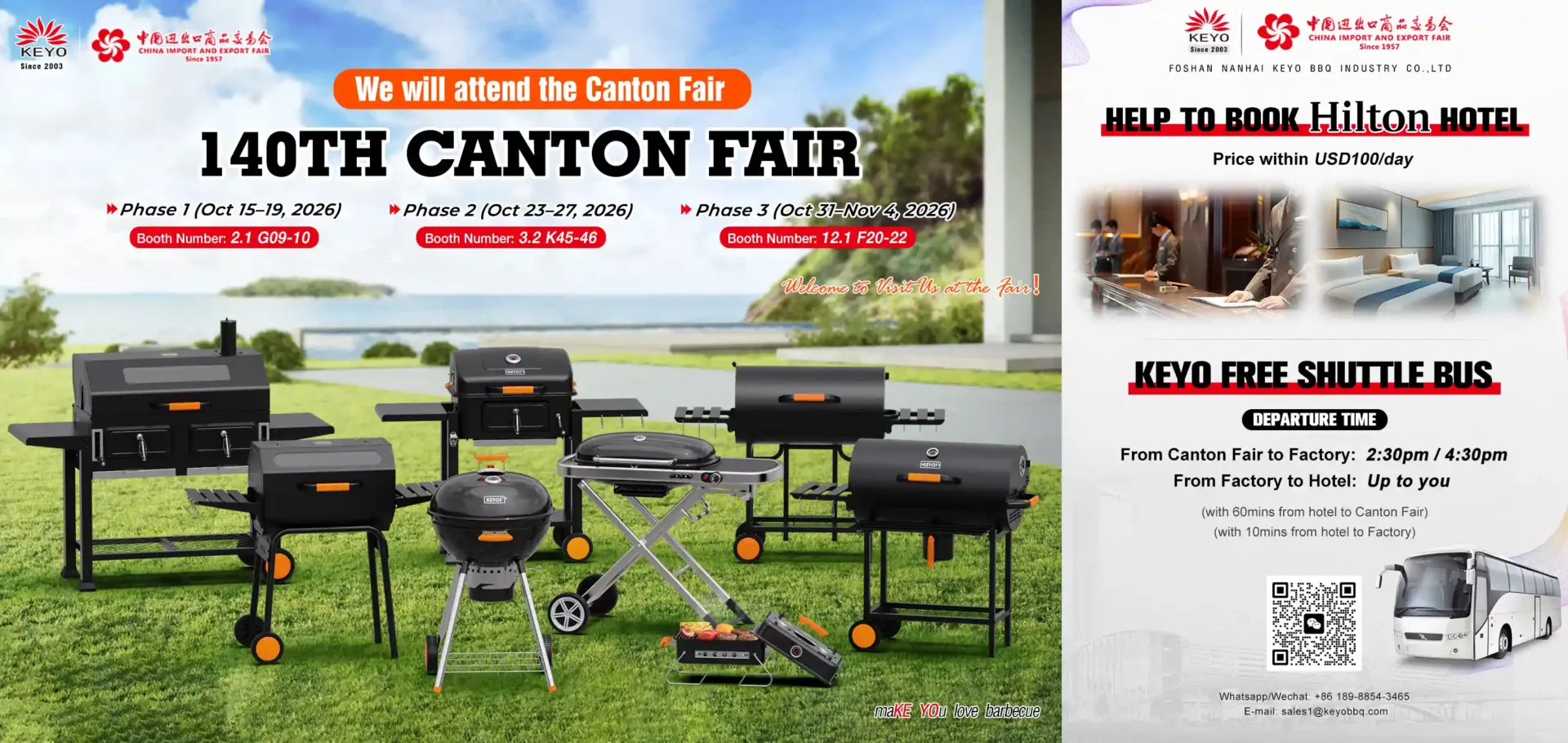
Meet KEYO BBQ at the 140th Canton Fair
Buyers attending the 140th Canton Fair can meet KEYO BBQ in person to discuss grill specifications, OEM/ODM requirements, and potential factory visits. Visit us during Phase 1 (October 15–19, 2026, Booth 2.1 G09-10), Phase 2 (October 23–27, Booth 3.2 K45-46), or Phase 3 (October 31–November 4, Booth 12.1 F20-22). KEYO BBQ also offers free shuttle services from the Canton Fair to the factory at 2:30 PM and 4:30 PM, along with hotel booking assistance. Contact sales1@keyobbq.com to arrange your visit.
FAQ
Q: What should buyers confirm before placing an OEM kettle charcoal BBQ order?
A: Confirm dimensions, material, configuration, customization scope, approved sample, packaging, compliance requirements, order quantity, and the process for approving production changes.
Q: What documents should an importer request from a BBQ grill supplier before ordering?
A: Request information relevant to the specific project, including the product specification, sample confirmation, quality requirements, applicable compliance evidence, packaging details, and commercial terms.
Q: How can importers verify an OEM BBQ grill supplier before mass production?
A: Start with an approved sample and written specification. Then confirm production responsibilities, QC stages, change control, packaging, and the final inspection process before mass production begins.
Q: Should an importer buy from a BBQ grill supplier or a wholesale distributor?
A: It depends on purchasing needs. Direct sourcing may suit projects requiring OEM development and closer production coordination, while distributors may be useful when the buyer prioritizes ready-made assortment or different ordering arrangements.